
The Mosaic
A story of then (2021) and now (2071)Bright News, 20 July 2071
Remembering plastic and the cult of convenience
Locals share the story and the culture behind the 50-year-old plastic mosaic rediscovered on Brighton Seafront last month.
Following last month’s discovery of an old walkway lined with rainbow waves of bottle tops below the shingle on the tideline of Brighton Beach, three local residents shared their stories about the era and the artwork.
A plaque at the site indicates that a mural was created in 2021 to thank local beach cleaners who faced the apparently monumental task of removing litter from the City’s beaches. The mosaic was made from bottle tops collected on the beach and along the beachfront over 8 months in 2018. Local council archives show that litter was an immense problem from the 1980s through to the mid-2020s because of the throwaway culture that existed in the country – and indeed in the world – at that time.
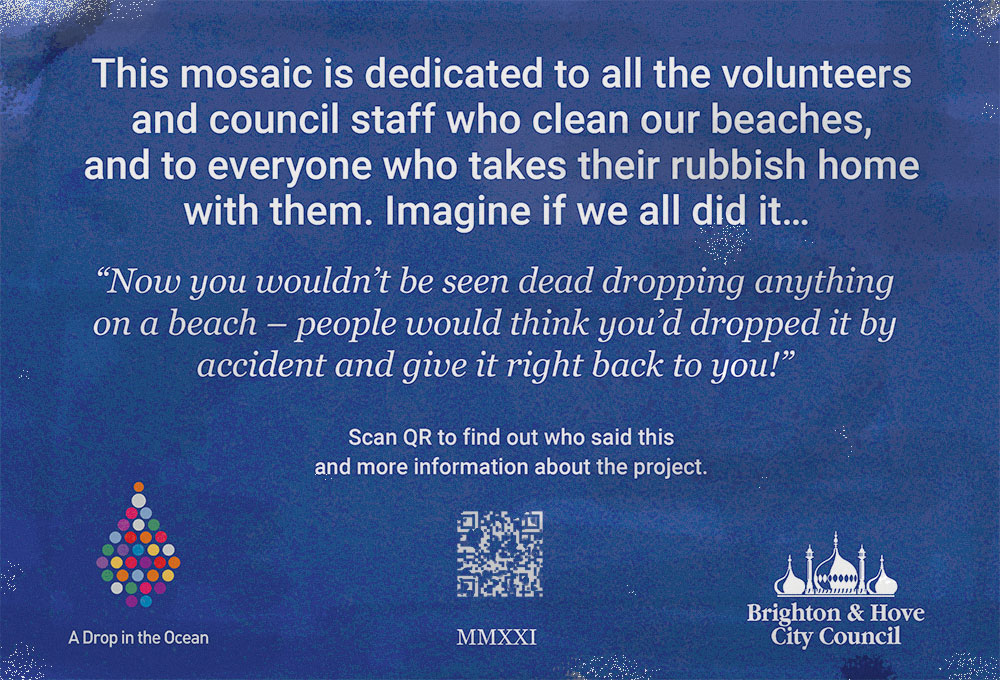
The old sign found at the mosaic
According to former beach cleaner Arnold James (95), the Brighton & Hove beach-cleaning teams would remove hundreds of tonnes of litter from the beaches each year.
“Things were very different then to what they are now. We’d spend hours and hours cleaning the beaches. Very few people carried their own cups and water bottles back then, and there were no water fountains. Everything came in plastic. You’d just buy a single-use bottle with a drink in it and chuck it when you were done. If it was a hot day, people would come down to the beach with plastic bags of ready-made store-bought meals and drinks, and at the end of the day they’d just leave everything right there for the wind to blow away, or the tide to wash into the sea, or the beach cleaners to pick up. So many birds and animals died because of it. There was no concept of taking your rubbish home with you. It’s hard to imagine now, with plastic being used for important things only, and people being so careful with what they use.”
Mr James worked as a beach cleaner until 2030, when a big cultural change made beach cleaners unnecessary.
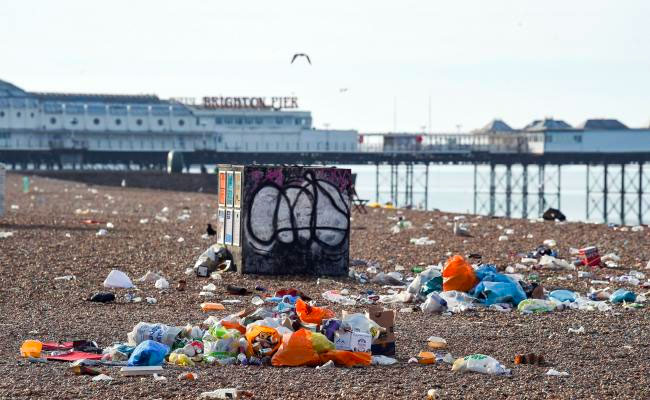
From The Argus Archive: Street cleansing staff from Brighton and Hove City Council had to clean up a mountain of waste left by beachgoers.
Local hairdresser, Jenni Fondant (68), was a teenager at the time the mosaic was made.
“I remember that project. I was working in a snack kiosk on the pier, and we collected bottle tops for it. The point was to show how much little bits of plastic add up. In a couple of months, they’d collected thousands and thousands of tops and displayed them as a rainbow wave on a fence by the sea. I hated going to the beach in the summer in those days because the amount of rubbish was awful. I remember one particularly hot weekend towards the end of the COVID-19 pandemic, they removed more than 30 tons of litter from the beach. That blew my mind! That people could bring the equivalent of five elephants worth of rubbish to a beach and leave it there in one weekend. What were we thinking?
Luckily things changed pretty fast after that. It became totally unacceptable to litter and the “supermarkets” we had at the time had to change the way they sold things. You had to take your own containers and bags to buy anything, and you carried a bottle with you everywhere, even your own knife and fork. We got used to it all really fast and I struggle to remember the way it was. Now you’d not be seen dead dropping anything on a beach, or anywhere – people would think you’d dropped it by accident and give it right back to you!”
Jaz Bellis (73) was living in London when the mosaic was made, but moved to Brighton in 2025. They were a regular day-tripper to Brighton beach while they were a student.
“I loved coming to Brighton. It was a complete escape from London. We’d bring loads of snacks and drinks and hang out on the pebbles for hours – wade in the sea on super-hot days. It was always buzzing. To be honest, back then I never thought twice about getting up and leaving whatever I’d brought behind me. I think it was probably because I felt no connection to the beach as an ‘environment’, if that makes sense? It seems strange to me now, given how much I value it. It was just a place to hang out and have fun, and everything would be cleaned up by someone else. That litter would blow into the sea or go out on the next tide didn’t cross my mind. I couldn’t be bothered to take it home with me. Even after moving here, it was a few years before I had an “aha” moment about what all the waste actually meant for wildlife and the impact of plastic getting into our food and water. I used to cross onto the beach using the underpass where the mosaic is, and I remember thinking “What a lot of bottle tops”, but still not putting two and two together.
Things have definitely changed for the better since those days. Now I just refill my bottle or my infinity glass at the drinks depots along the seafront. And often I pick a few pieces of fruit from the street orchards as I’m heading down to the beach. We even managed to restore a kelp forest in our coastline which has increased the biodiversity exponentially. I couldn’t have imagined that happening. I know old people always say ‘things have changed since my day’, but they really have. You wouldn’t want it to go back to the way it was.”
The mosaic is being excavated from the seafront and will be moved to the Brighton & Hove Museum next month, where it will be a central piece in a new exhibition titled: Plastic and the cult of convenience. The exhibition will open in January 2072.
ABOUT THE PROJECT
The Mosaic was the third and final phase of A Drop in The Ocean. Every one of the bottle tops that was used to create The Wave on the fence of the Volk’s Railway, was used to create a mosaic as a tribute for all the volunteers and council staff who work tirelessly to clear the shingle and protect local sea- and birdlife in doing so.
You can see the mural in the walkway that passes under the Volk’s Railway track just east of the Volk’s Visitors Centre on the Brighton seafront. It’s also a monument to the incredible durability of plastic, which is an astounding material, but one that should never have been used as it has been for single-use convenience.
The story above was inspired by the second phase of the project – Conversations Under the Chandelier, where we invited people to imagine changes we could make for a better future for our City and our planet by asking them “What if…”.